
About us
Balansekunst is a national resource centre and membership organisation that brings together the cultural sector in a shared effort to promote equality and diversity.
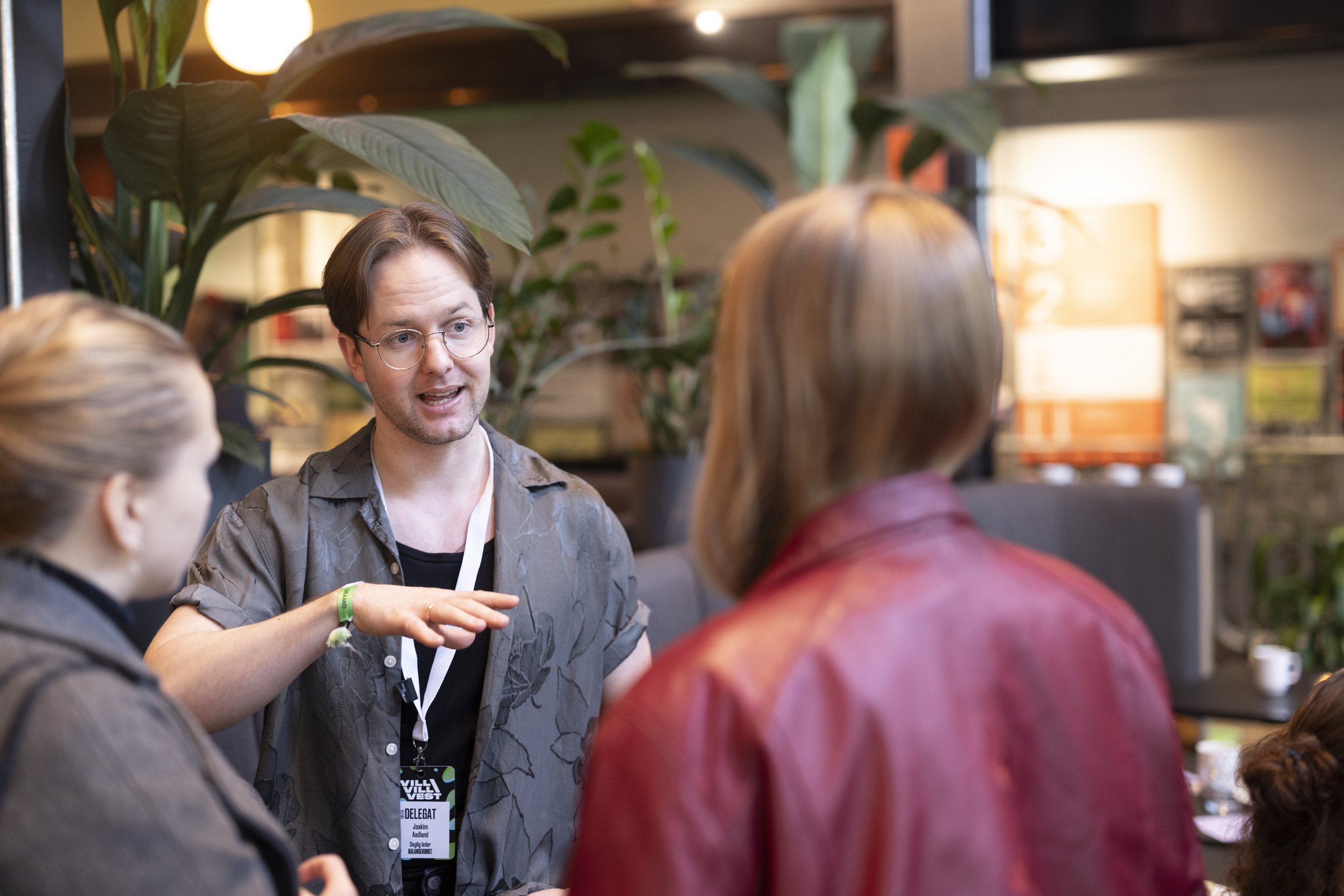
General manager, Joakim Aadland. Foto: Øystein Haara
The diversity of our society is not reflected in the cultural sector. Many face barriers that make it difficult to participate — whether as artists, cultural workers, or audiences. Balansekunst works to make the cultural sector more open and accessible, so that everyone has real and equal opportunities to participate, create, and work in the Norwegian cultural sector.
Learn more about our employees and board.
Our work
Balansekunst supports cultural organisations in strengthening equality and diversity. We provide resources, practical tools, training and guidance, project funding, and legal advice to help create a safer and more accessible cultural sector.
-
We organize gatherings and meetings where our members can network and learn from each other's experiences.
We collaborate with our members on joint events focused on equality and diversity in the cultural sector.
We provide training and guidance to our members in equality and diversity work.
We offer funding for our members' diversity and equality projects through our grant programme, Balansepotten.
-
We operate a free helpline providing legal advice to individuals who have experienced or witnessed sexual harassment, discrimination, or abuse of power in the cultural sector.
We advise our members on risk assessment, development of reporting procedures, and internal guidelines.
-
We provide courses on equality and diversity for cultural institutions.
We develop resources to support cultural institutions in their own diversity and equality efforts.
We share expertise through media statements, opinion pieces, panel discussions, debates, and social media.
-
We hold regular meetings with members of parliament, local politicians, and decision-making authorities to highlight both challenges and solutions for a diverse and equitable cultural field.
We advocate for increased financial support for the cultural sector and its own diversity and equality projects through political lobbying.
We participate in hearings and provide input to parliament.
We offer input for national and municipal action plans.
We participate in and organize panel discussions, debates, and conversations.
We raise awareness of diversity and equality efforts in the media through opinion pieces, debates, and interviews.
Our vision
We believe that a rich and vibrant cultural sector needs a diversity of perspectives and voices. The sector must be open, accessible, and inclusive, so that everyone can experience art and culture from a wide range of perspectives and expressions. That is why we work for:
-
There are many risk factors for discrimination, sexual harassment, and abuse of power in the cultural sector. Every organization should take preventive action and implement active measures to create safe and equitable workplaces.
-
Why does the Norwegian cultural sector not fully reflect the diversity of its population?
From economic barriers and closed networks to prejudice, norms, language, and unwritten codes, many factors influence who feels able to participate. Working to strengthen diversity means identifying both visible and subtle barriers that prevent certain groups from taking part.
-
Working to strengthen diversity involves recognizing bias and structural barriers to equality, while valuing a wide range of perspectives and artistic expressions. Diversity-conscious recruitment recognizes that knowledge of, experience from, and networks within minority communities represent valuable expertise. In programming and booking, a diversity-conscious approach broadens artistic expression, enriches programs, and helps organizations reach new audiences.
-
Power structures shape how we define art and quality. What is considered good, relevant, or interesting art is influenced by social norms, networks, and personal experience.
When a homogeneous group defines what is seen as good, interesting, or relevant, diversity is limited.
To build a cultural sector that includes a wide range of artistic expressions and people from all parts of society, we must acknowledge how informal networks, power structures, and our own biases can exclude certain individuals and voices.
-
Advocating for diversity and equality in the cultural sector does not impede artistic freedom. On the contrary, it fosters stronger artistic processes for all.
True freedom requires the ability to create art in supportive working environments, free from discrimination and sexual harassment. To ensure this freedom for everyone in the cultural sector, we must dismantle barriers that hinder certain groups while also amplifying a broader range of voices.
Our history
-
In 2009, key actors in the Norwegian music sector came together to establish the Balansekunst Network, with the aim of advancing gender equality in the industry. The year before, Astrid Kvalbein and Anne Lorentzen, in their anthology Musikk og kjønn – i utakt? (Music and Gender – Out of Tune?), commissioned by the Norwegian Arts Council, highlighted a concerning trend: efforts to improve gender balance in the Norwegian music industry were largely ad hoc or driven by external pressure, rather than initiated within the sector itself. The establishment of the Balansekunst Network marked a significant shift in this approach.
-
In 2012, the first Balansekunst conference, Balanse i musikken (Balance in Music), was held. A significant milestone followed in 2013, when the Norwegian Arts Council, based on Balansekunst’s recommendation, established a pilot programme with NOK 1 million to support efforts to improve gender balance in the music industry. This initiative was discontinued later that year following a change of government.
-
Until 2016, Balansekunst operated as a network. In 2016, we were formally established as an association to strengthen our organizational structure.
That same year, our mandate was also expanded to include a broader understanding of diversity, recognizing that efforts to combat gender discrimination must address interconnected societal factors. -
In 2017, Balansekunst expanded our scope from being an initiative for the music industry to becoming a resource for the entire cultural sector.
That same year, in the wake of the #MeToo movement, Balansekunst launched targeted efforts to prevent and address sexual harassment in the cultural sector.
-
In 2019, Balansekunst received government funding for the first time to develop Balansemerket, a certification scheme for a safe cultural environment.
In 2020, we received NOK 2.3 million in operating grants from the Ministry of Culture. This was increased to NOK 5.6 million in 2023.
Since 2023, we have had six full-time employees.